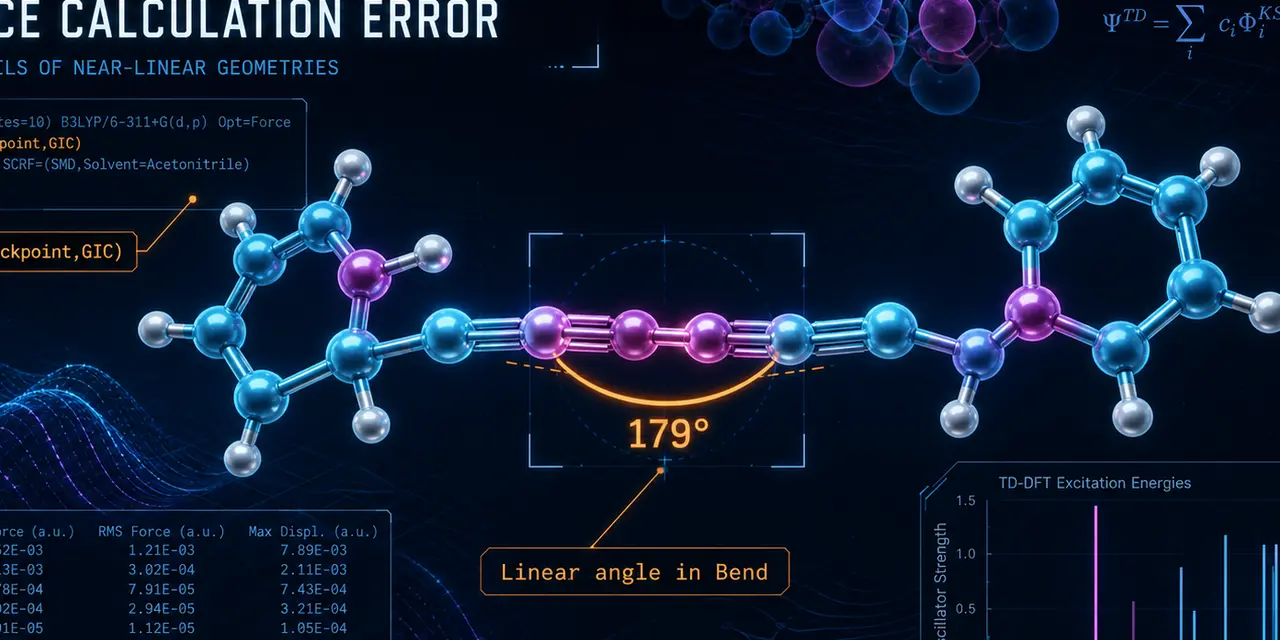
TD Force Calculation — "Linear Angle in Bend" Error
Problem
The Linear angle in Bend error repeatedly occurs during the TD force calculation for the triplet state of the IDT–ZnP molecule.
Initial observation
- When the Gaussian log file is opened in GaussView, the automatically generated connectivity/Z-matrix appears unusual.
- Several angles close to 179° are defined between atoms or groups that are not directly bonded.
- This initially suggested that incorrect molecular connectivity might be causing Gaussian to construct problematic internal coordinates.
Connectivity test
In GaussView, used:
Atom List Editor → Edit → Reconnect All Atoms by Bonding
After reconnection:
- The molecular connectivity appeared more reasonable.
- The remaining nearly linear angles corresponded primarily to physically meaningful bonds, especially the triple-bond bridges.
- New Gaussian inputs were generated with explicit connectivity appended below the Cartesian coordinates.
Opt + Freqand TD force calculations were then repeated.
Result
Explicitly correcting and providing the molecular connectivity did not resolve the Linear angle in Bend error.
This indicates that the problem is probably not caused by incorrect bond connectivity itself.
Working solution
Using
Geom=(Checkpoint,GIC)
for the TD force calculation successfully avoids the error.
The issue therefore appears to originate from Gaussian's default redundant internal coordinate (RIC) representation. The nearly linear geometries associated with the triple-bond bridges can produce problematic bending coordinates in the default RIC set.
Using GIC (Generalized Internal Coordinates) for the force calculation prevents the problematic linear-bend coordinate from causing the calculation to fail.
Current workflow
- Perform geometry optimization using the default RIC coordinates.
- Perform the frequency calculation using the default RIC coordinates.
- Use the resulting checkpoint file for the excited-state TD force calculation.
- Run the TD force step with:
Geom=(Checkpoint,GIC)
- Use the resulting force information for the final resonance Raman (RR) calculation.
Conclusion
- Explicit molecular connectivity does not fix the problem.
- The optimized structure and frequency calculation using the default RIC coordinates appear to be valid.
- The failure is specific to force generation when Gaussian encounters nearly linear bending coordinates in the default RIC representation.
- Switching the TD force calculation to GIC successfully resolves the
Linear angle in Benderror. - Therefore, it appears acceptable to retain the default RIC-based
Opt + Freqresults for the final RR calculation while using GIC specifically for the TD force step.